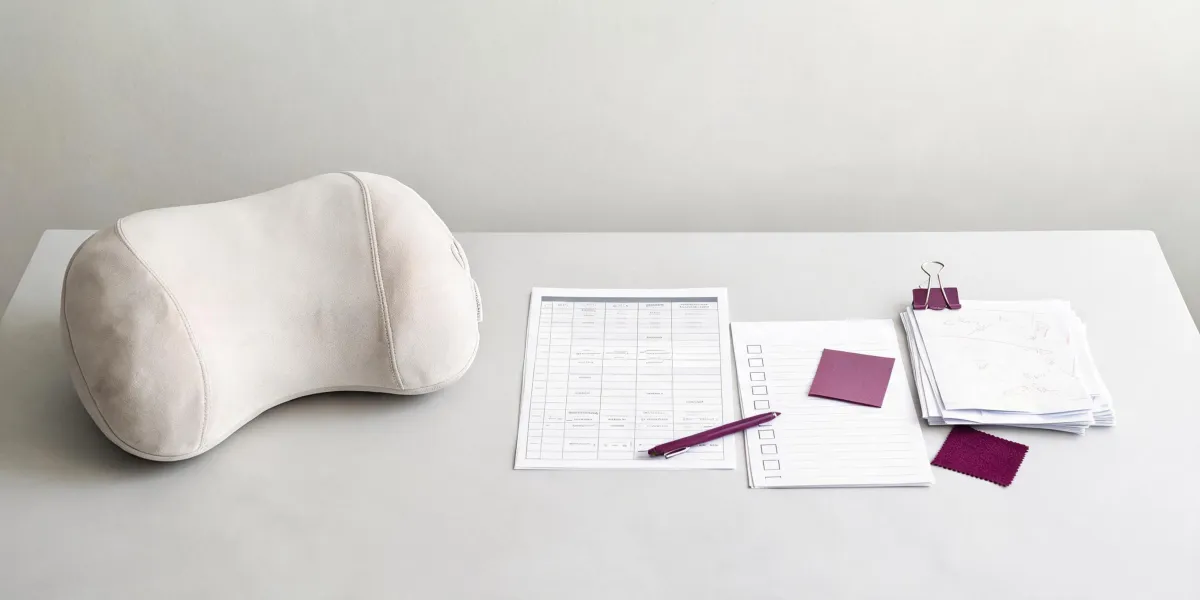
Where exactly does this pillow sit on your neck, and why does it keep catching your skin? The SP-25H instruction sheet answers both: neck, back and shoulders, and the pinching it warns about comes from leaning on the mechanism while you reposition, not from the massage. Everything here stays tied to the Homedics SP-25H and the manual version on file. Other cushions run different node layouts, different cushion openings and different limits.
Buyers get this backwards. A nip feels like a bad unit, so they return it, and the replacement behaves the same way on the second session. The device is doing exactly what a rotating mechanism does. Your job is to stop feeding it slack.
What the SP-25H Pillow Is Actually For
The sheet calls the Shiatsu Pillow versatile and designed for use on the neck, back and shoulders, with Figures 3 and 4 carrying the placement detail. Read that as a zoning statement rather than a health claim. A manufacturer writes down intended areas and operating limits because those are the things it can be held to. It stays quiet on outcomes because an instruction sheet is not where outcomes get established.
That line is useful for exactly one decision: whether your problem area is on the approved list. Neck, back, shoulders. If you bought it hoping to work a hip or a calf, the sheet does not cover that placement, and no amount of improvising turns a cushion shaped for the upper body into something else.
Versatile, in this context, means several approved zones on one body region. It does not mean the device adapts to you. The shape is what it is, and the variation comes from where you put your body, not from what the unit decides to do.
How a Shiatsu Cushion Differs From a Handheld Massager
With a handheld massager, the tool moves and your body stays put. With this cushion, the tool stays put and your body moves over it, which means the skill changes. You are no longer steering a device. You are deciding how much of your weight to set on a spinning node.
Against a massage chair, the difference comes down to support. A chair holds your torso and neck at a set angle, so the load you add is small and predictable. A pillow leaned against a couch leaves your neck carrying its own weight, and you supply the rest by pressing back into the nodes. That second part is what readers underestimate when they compare the two.
Suppose someone uses the cushion the way they use a handheld, pushing back into the nodes to chase more pressure. That is the loading direction the sheet warns about, and it is a habit rather than a defect, so the fix is behavioral rather than mechanical.
Why Pinching Happens Where the Nodes Travel
Chain it from the hardware. The massage comes from nodes rotating inside the cushion. Those nodes need an opening in the surface in order to reach you. Anything with slack that ends up between a moving node and the edge of that opening gets drawn in: skin, hair, a shirt hem, a loose sleeve.
Because the nodes keep turning while your weight sits on them, the risk concentrates in movement rather than in stillness. Settled contact is fine. Hunting for position while leaning is not. The sheet's wording tracks the physics: to avoid pinching, do not lean on the shiatsu back massage mechanism in the cushion when adjusting your body position, and do not jam or force any part of your body into the moving mechanism.
Jamming is the clause people skip. It is what happens when the pillow feels like it sits too low and you try to shove a shoulder under it without getting up first. The instruction exists because the mechanism does not stop for you.
Pillow First, Then Your Body
Set it where you want it, then bring your neck to it. That is the whole method, and it runs opposite to what most people do on a couch, which is sit down first and then wriggle into the cushion until something feels right.
Think of sliding a chair up to the table before you sit, not after. Positioning is cheap while nothing is touching you and expensive once your weight is on a rotating node, which is why the arrangement has to happen at zero load.
In practice: power off, plant the unit against the backrest at the height you want, sit or lean back, and only then settle your neck or shoulder into the cushion. Any shuffling, whether that is scooting, straightening up or reaching for a drink, happens before contact rather than on top of the mechanism. The sheet sets the same order in negative form: adjust your body position without leaning on the mechanism, and never force a body part into it.
Seat height does more work than most buyers expect. The load path runs from your torso down into the cushion, so a chair that lets your neck rest without pushing spares you a string of small corrections. A deep couch or a low backrest changes the angle of that path and puts more of the work in your neck rather than in the cushion.
Why Gentle Pressure Is the Whole Point
The sheet asks for only gentle force against the unit, so that any or all risk of injury is eliminated, and notes that you may soften the massage force by placing a towel between yourself and the unit.
Read the towel line as a design statement. Force is treated as your input. The pressure you feel is your body weight plus however hard you press back, which means intensity is set by posture and by a barrier layer: sitting more upright, letting your shoulders drop, folding a towel over the contact point.
The reason that matters is that buyers shop for intensity as if it were a spec on the box, and a firmer session reads as a more effective one. The sheet redirects that: its remedy is a layer between you and the unit. It costs nothing.
Keep the boundary in view. A barrier changes comfort and contact; it does not change what the device is. This is a cushion with rotating nodes, and the sheet that describes it is an operating document.
What This Manual Does Not Promise You
The sheet documents intended body areas, a reference to the placement figures, and force limits. It does not establish that a session helps any condition. No independent clinical study for this model came with the material, and nothing in this article should be read as a rehabilitation or pain-treatment guarantee.
That gap is not a reason to walk away. It is a reason to buy on fit instead of hope. Since the force comes from your own loading, three questions decide whether the unit earns a place in your room.
Does your usual chair or couch let you lean back with a relaxed neck, or does it leave you propping your head up? Does the cord reach from that seat to an outlet without crossing a walking path? And does the unit have somewhere to live between sessions, or will it end up on the couch as another thing to move?
A no on the first question is the one that sinks the purchase. Placement advice needs furniture to work with. If no seat in your home lets you lean back at the height the unit needs, no feature listed on the box changes that, at any price.
Tonight, do one small thing: put a folded towel within reach of the chair you use, and next session start with it under your neck or shoulder instead of pressing harder when the contact feels sharp. Two sessions from now you will know whether the placement or the pressure was the problem.
